


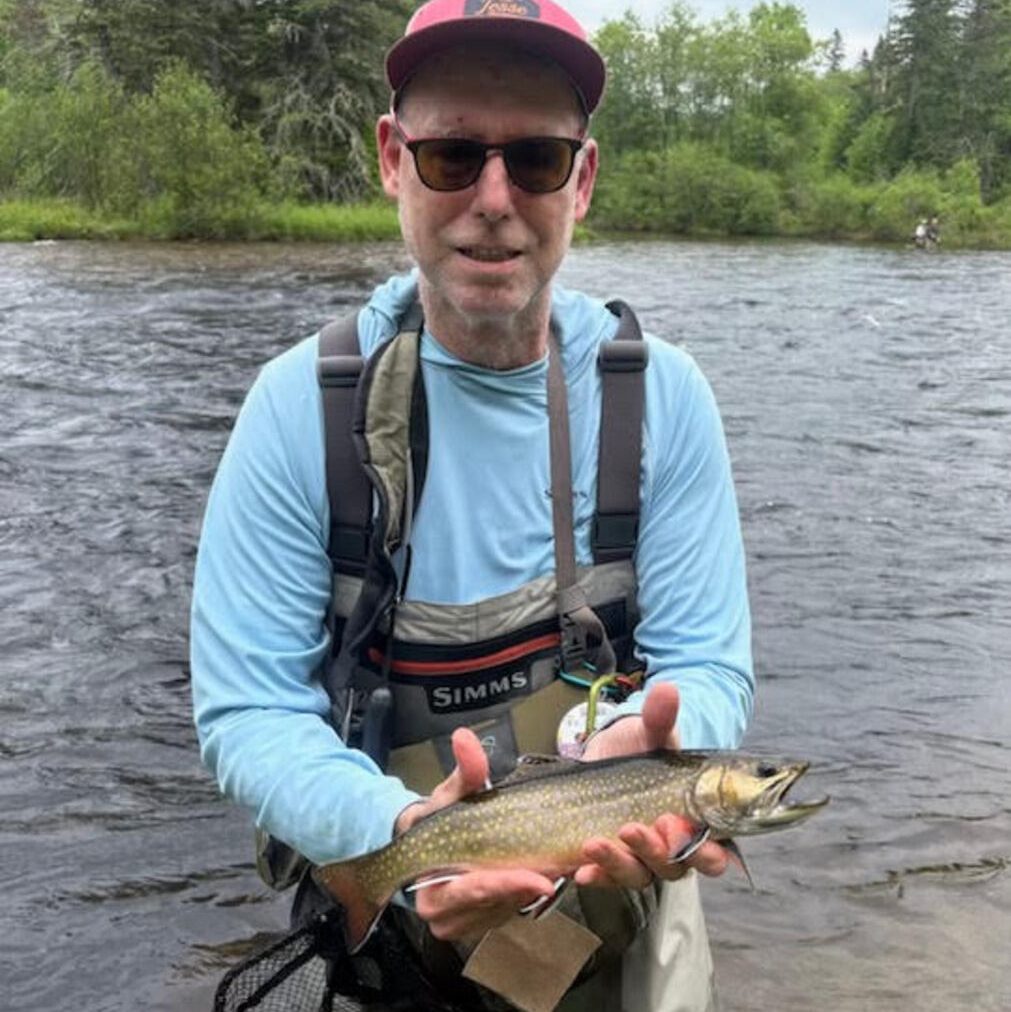

After a hiatus of a few years, I returned to the West Branch of the Penobscot River with Robert, my fishing partner, in late September.
It’s almost always a competition between the WB and the Rapid River for our fall sojourn. The WB usually comes in second place. This has nothing to do with a lack of appreciation for the West Branch. Rather, it usually boils down to two factors.
First, the Rapid is a couple of hours closer for us. Second, economics. A friend-of-a-friend connection grants us free use of a very nice log cabin that is maybe 10 minutes from Middle Dam Road. Free lodging is hard to beat.
Nonetheless, this year the WB won out.
As Mount Katahdin came into view when we crossed Abol Bridge, workaday worries were put in the rearview mirror and our thoughts turned to getting on the water.
Well, there was also some anxiety about the killing of thousands of trout and salmon in July when Brookfield Renewables’ McKay power station went offline and caused a precipitous drop in water flow. We wondered how badly the fish population had been affected and, on a more self-interested level, whether the fishing would be horrible.
We had a good trip and found fish, although we did not catch that many. We landed at least some salmon each day of our three-day visit but hardly set the world on fire.
I kept losing fish — missing hooksets or, worse, hooking up only to lose them two, five or 10 seconds later for no apparent reason.
More than once, a passerby might have seen me staring at my hands as if they had betrayed me, like an NFL receiver who had just dropped an easy touchdown pass. That same passerby may have also heard some colorful language.
There were impressive caddis hatches that began each afternoon and continued, ebbing and flowing, until nearly full dark.
Sarah Sindo, the manager at Chewonki Big Eddy Campground, which is a great place to stay, told us to expect white caddis. That was not on my bingo card or, unfortunately, in my fly box.
Just as Sarah had predicted, relatively large white or cream-colored caddis, perhaps size 14, predominated. I may be wrong about the size because I did not capture a specimen and, at least to me, caddis always look larger in flight than they actually are.
There were other caddis species in the mix, including a small brown-bodied caddis with brown-mottled wings that looked to be size 18.
I eventually hooked a trout on a size 14 tan Elk Hair Caddis, which was as close as I could get to white from my fly selection.
The hit came when I mended my line and quite accidentally skittered the fly in front of a cooperative fish. I had it on for about 15 seconds before my line went slack. There were no other takers.

Robert hooked a nice salmon on a size 12 white Wulff, which may or may not have been taken as a white caddis. After three or four jumps, it threw the fly and fled the jurisdiction.
Robert abandoned hatch matching and caught a small brookie on a Hornberg and another on a streamer.
The fish were rising to the caddis in a big way.
“Rising” seems an inadequate description. “Launching” seems more appropriate for the splashy takes so characteristic of trout and salmon that are dining on caddis.
As the sun went down, lending a pewter cast to the river’s surface, the risers stood out in bold relief, appearing as black silhouettes against the dull shine of the water.
The fish were seemingly abundant and avidly feeding, although the ones that put on the most ostentatious aerial displays tended to be smaller fish.
It was good to see and allayed my worst fears about the fish kill.
There surely was damage done, with Trout Unlimited estimating 6,000 to 12,000 fish deaths, but from my amateur, profoundly unscientific observations, significant numbers of trout and salmon remain in the river.
I am utterly unqualified to assess what this fish kill will portend for future generations of trout and salmon, but like many anglers, I have concerns.
Brookfield’s license is due for renewal right now. I have no illusions about Brookfield losing its license. That seems highly unlikely for a number of reasons.
But I hope the renewal process will provide an opportunity to clarify what further concrete measures it must take to protect the river and the fish that live in it.

Lessons learned
Maybe you can never have too many caddis patterns.
Trying to simplify one’s fly-fishing life is a laudable goal, but do not go overboard.
I have made a concerted effort to avoid carrying enough flies to stock a fly shop each time I go to a river. I think that squeezing numerous fly boxes into one’s vest or waist pack is ultimately counterproductive.
It is the problem of too many choices. I cannot quickly find what I am looking for and tend to waste time staring blankly at row after row of flies when I should have a fly in the water.
But avoid paring down so much that you are left unprepared, as I was during the West Branch caddis hatches.
Even my full collection might not have included a white-bodied caddis imitation, but it would have given me a better chance of cracking the code.
For fall trips, I usually carry only a couple of size 14-16 tan Elk Hair Caddis, a few tan CDC caddis in the same sizes and several larger, orange-bodied soft hackles for October caddis — though none of the latter have ever fooled a fish for me.

Instead, I rely on size 16-18 Adams or BWO dries in several styles, plus matching emergers and nymphs, on the theory that BWOs dominate the fall shoulder season.
Given their abundance in New England waters, caddis may be a particularly bad fly on which to skimp at any time of the year.
In the future, I will make sure to have size 12 to 18 caddis in at least the following flavors: tan, brown, olive, apple green, gray and white. I will keep them in a separate box so they are easy to find.
As I write this, I am preparing to take at least a shallow dive into Thomas Ames Jr.’s fine book “Pocket Guide to Eastern Hatches” to see if I can discern what caddis patterns I really need when I next go to the West Branch during September.
And yes, it may have been smart to take that dive before my trip.
Patience is a virtue when streamer fishing
One reason that Robert is a very effective streamer fisherman is that he keeps at it even when nothing is happening for long stretches.
I, on the other hand, will switch over to nymphing when I tire of pulling streamers. Twenty minutes or so of no action is usually enough for me to lean my streamer rod against a tree.
I need to hang in there a bit longer if I want to get results.
For what it is worth, white and orange were the streamer colors that brought Robert some success this time around.
The biggest fish of the trip, which is pictured, was caught on a white conehead Zuddler with an orange highlight.
Keep the faith with BWO nymphs
If the calendar says September, don’t forget to try BWO nymphs even if it’s sunny out.
I associate BWOs with cloudy, cool and rainy September days, but BWO nymphs can be effective in nice weather.
The two patterns that accounted for whatever very limited success I experienced during this trip were Hilga’s Olive SOS (size 16), the tutorial for which can be found on the Fly Fish Food website, and what I guess I will call the “No-name BWO nymph.”

I should not have naming rights as I didn’t invent the fly, but I don’t recall where I found it and thus cannot credit whoever did come up with the pattern.
It’s tied on a size 14 or 16 jig hook, has an olive thread body ribbed with pearl Flashabou, an olive Ice Dub thorax, a natural CDC collar and a matching silver bead.
The recipe I use has no tail. But I expect adding a few CDL fibers would not hurt and might even make the fly better.
These two flies were drawing occasional hits even when bluebird skies prevailed.
Make the extra effort to tie durable flies
I take some pride in tying effective and durable flies.
This trip showed me I am not “all that” and still have things to learn as far as making my flies bulletproof.
I was fishing a WD-40 that I thought I had really nailed. Mallard flank tail and wing case, tobacco-colored thread abdomen and a nice bulbous olive thorax. It looked pretty fishy to me.
But after it bounced on a few rocks as part of a two-nymph rig, I saw that the thread on the abdomen was unraveling. Not good.
I generally put a skim of superglue, applied with a toothpick, on the half-inch of thread closest to the fly before I whip-finish. That does a good job keeping the finishing knot from coming undone.
But I think I need to start putting a thin coat of epoxy or other adhesive on thread bodies, whether they are unadorned, like the WD-40, or have a wire rib, like a Zebra Midge.
I think any adhesive would help mitigate the problem. Resin may be the most effective product to use, but nail polish or superglue would probably work as well.